NYC Mansion Tax & RPTT(Transfer Tax) 2026
NYC Mansion Tax 2026: What Every Buyer and Seller Needs to Know
A proposed expansion of the mansion tax would hit New York City property transactions as low as $500,000 for the first time ever. With a June 1, 2026 proposed effective date, here is what every buyer and seller in New York City needs to understand right now.
New York City's real estate landscape is shifting in a way that has not happened before. A proposed expansion of the mansion tax, currently moving through the state budget process, would apply this tax to properties as low as $500,000 for the very first time. If you are buying or selling anywhere in New York City, this is a conversation you need to be part of now.
The New York State Senate and Assembly released their One-House budget proposals in March 2026, both of which included a significant restructuring of the existing mansion tax framework. The proposed changes would not only increase rates at the upper end of the market but would extend the tax to an entirely new price bracket, one that covers a substantial portion of all residential transactions across the five boroughs.
Two Different Taxes: Understanding the Distinction
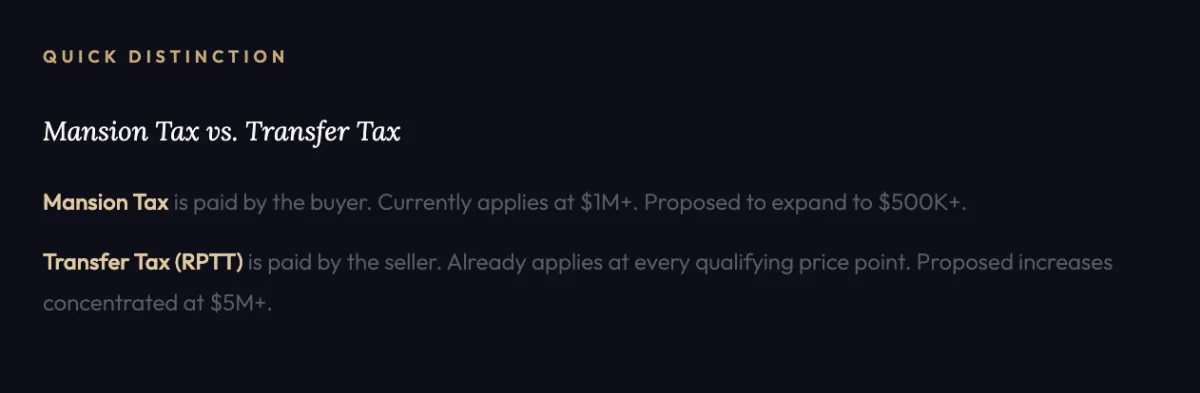
Before diving into the proposed changes, it is important to be clear on the difference between two taxes that are often confused. They affect buyers and sellers differently and are not interchangeable.
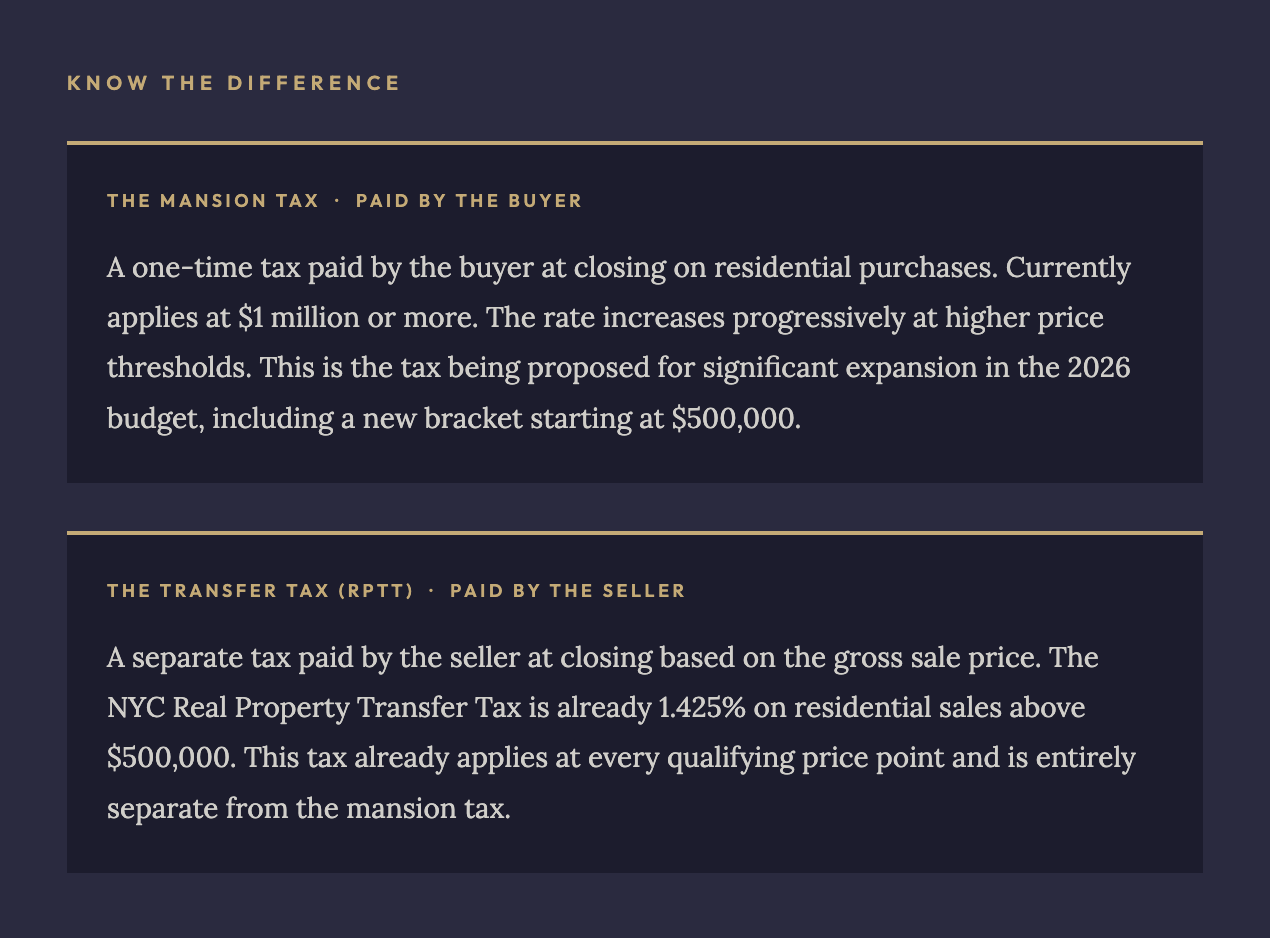
The budget proposals touch both taxes, but the mansion tax expansion to the $500,000 threshold is the more dramatic and far-reaching change for the broadest range of transactions. The transfer tax increases in the proposal are concentrated at the $5 million and above tier. Both are worth understanding but they are separate obligations landing on different parties at closing.
What Is Changing and Who Proposed It
There are two distinct policy tracks moving simultaneously, and they come from different sources with different levels of momentum.
The first is the Senate and Assembly mansion tax expansion. Both chambers included this in their One-House budget proposals. Critically, Governor Hochul's executive budget does not include these mansion tax changes. This means the proposal still requires a negotiated agreement between the legislature and the Governor before it can become law.
The second is Mayor Mamdani's separate and narrower package, which targets the top of the market specifically. After significant political backlash to an earlier proposal for a 9.5% blanket property tax increase across all property classes, the administration shifted to a more targeted approach. That revised package includes a 1% annual property tax surcharge on Class 1 and Class 2 residential properties valued at $5 million or more, a 1% transfer tax on cash-only transactions above $1 million, and an expanded mansion tax-style levy on residential sales above $5 million. Together these measures are projected to raise approximately $1.2 billion annually.
The Mansion Tax Rate Changes: Current Law vs. Proposed
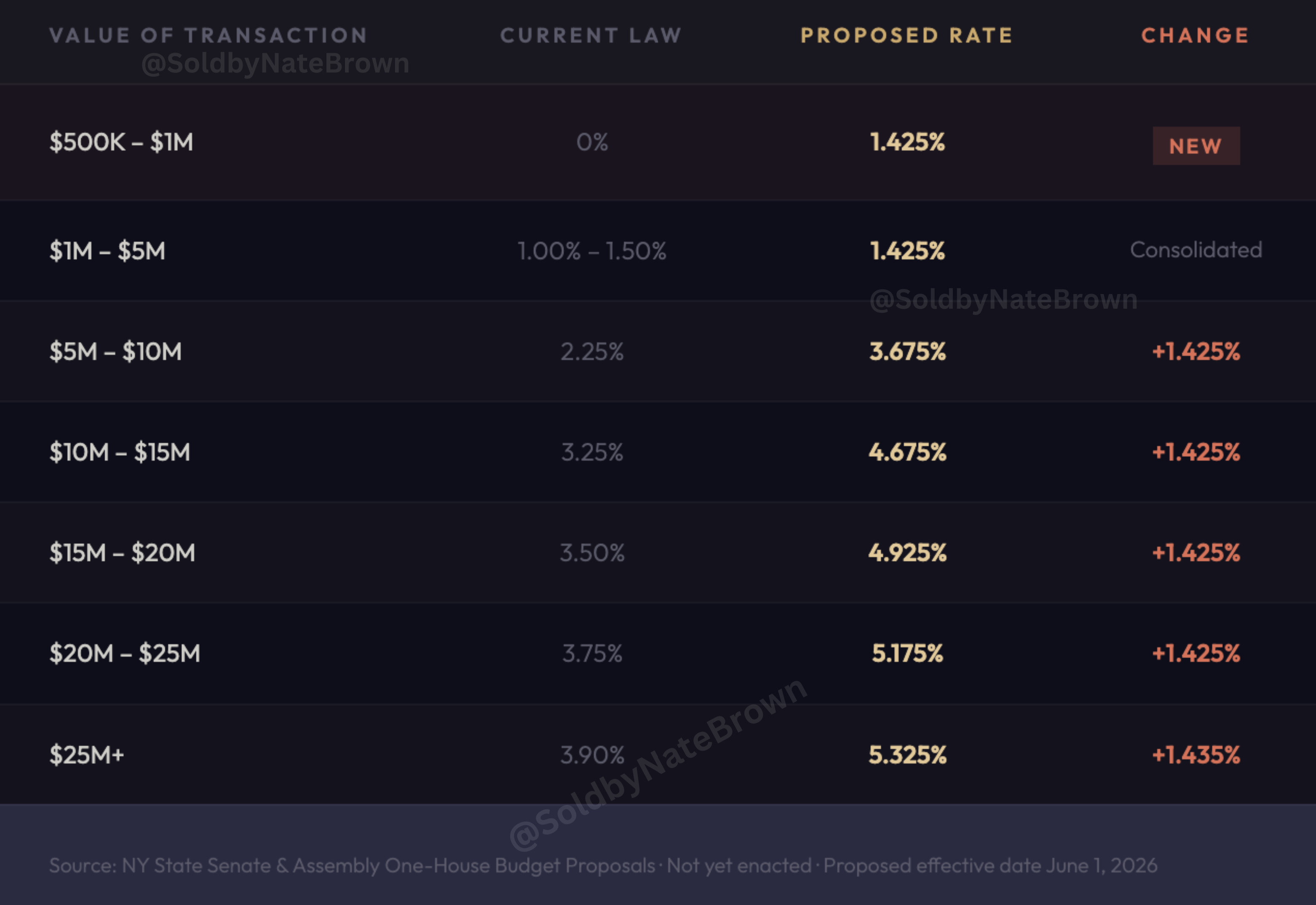
Under current law, the mansion tax does not apply to any residential purchase below $1 million. The proposed 2026 budget would drop that threshold to $500,000, creating an entirely new tax obligation for buyers in a price range that has never been subject to it.
FULL MANSION TAX RATE COMPARISON · CURRENT LAW VS. PROPOSED
What This Means in Real Dollars
$7,125
New cost on a $500K purchase vs currently $0
$12,825
New cost on a $900K purchase vs currently $0
$142,500
Additional cost on a $10M purchase vs. current law
For buyers purchasing in the $500,000 to $1 million range, this represents an entirely new line item at closing that has never existed before. It comes on top of existing transfer taxes, attorney fees, mortgage recording tax where applicable, and all other standard closing costs.
"For the first time ever, a buyer purchasing a $600,000 home in New York City would owe a mansion tax. That is the most significant shift in this proposal."
What This Means for Sellers
The mansion tax is paid by the buyer, not the seller. But sellers are not insulated from its effects. When closing costs rise for buyers, some exit the market entirely, others reduce their offer price to offset the new cost, and negotiations at every price point become more complicated.
Separately, sellers should be aware that the transfer tax, which is their responsibility at closing, already applies to every sale above $500,000 at a combined NYC and state rate of approximately 1.825%. The proposed budget changes to the transfer tax are concentrated at the $5 million and above threshold, so most sellers below that price point are not facing a new transfer tax burden. However the combined effect of both sets of changes on buyer behavior is something every seller should be thinking about.
The June 1 Deadline Is the Central Urgency
If passed with the proposed effective date intact, any transaction closing on or after June 1, 2026 would be subject to the new mansion tax rates. Since the average time from accepted offer to closing in New York City runs between 60 and 90 days, sellers aiming to close before the deadline need to be in contract very soon. For buyers, the same math applies in reverse.
What This Means for Buyers
If you are actively searching, the urgency to move is real. Closing before June 1 shields you from a new cost that could range from thousands of dollars on a mid-priced purchase to six figures on a luxury transaction. Work with your attorney and broker now to understand your specific exposure and factor the proposed new rates into your offer and negotiation strategy before the budget is finalized.
What History Tells Us About Taxes Like These
New York City's proposals do not exist in a vacuum. Los Angeles enacted a similar transfer tax on property sales above $5 million in 2022, and a 2025 study from UCLA's Lewis Center found that the odds of a Los Angeles property selling above the tax threshold fell by as much as 50% after the tax took effect, with especially sharp declines in non-single-family transactions. The study noted that while the tax raised meaningful revenue, it also slowed market turnover in ways that affected housing production and long-term property tax growth.
New York City's proposals are not identical to Los Angeles, but the behavioral question is the same. If taxes on high-value transfers rise significantly, do sellers, buyers, and investors step back from the market? In a city where home sales are already down 25% since 2022, that risk is worth taking seriously. The effects could extend beyond the luxury market. Because the majority of New York City renters live in Class 2 real estate, a surcharge on those buildings could translate into upward pressure on carrying costs and, ultimately, rents.
Two Proposals. One Urgent Timeline.
Whether it is the Senate and Assembly's proposed mansion tax expansion starting at $500,000, or Mayor Mamdani's narrower package targeting $5 million and above, the direction of tax policy in New York City is clearly trending in one direction. Governor Hochul has not endorsed the mansion tax expansion, and the final budget still requires negotiation. But both chambers advancing these proposals simultaneously gives them real momentum, and the proposed June 1 effective date means the window to act under current law is narrowing. Anyone with a transaction in progress or on the horizon should consult with their real estate advisor and attorney now.
"The sellers and buyers who act with intention before June 1 will be the ones who look back on this window as the moment they made the right call."
Sources & References
EY Tax News Update, March 19, 2026 · New York budget negotiations continue as Assembly and Senate bills are introduced
Realtor.com, March 25, 2026 · Mamdani property tax and luxury home sales
Tannenbaum Helpern, 2026 · Tax the Rich: Controversial NYC Tax Proposals and What They Could Mean for Taxpayers
NYC.gov, 2026 · Real Property Transfer Tax (RPTT)
Thinking About Selling?
Let's discuss positioning you appropriately for this market.
A focused conversation now, before you are ready to list, is where the real work begins.
To learn more about upcoming off-market listings or The Brownstone Collection as an owner or buyer, visit NateBrown.com/TheBrownstoneCollection or contact Nate Brown at 646.387.4469
Thank you for taking the time to read this post. Please like, comment, or share, and stay tuned for more updates!


